Why a gene can vanish by pure luck: genetic drift
30seconds
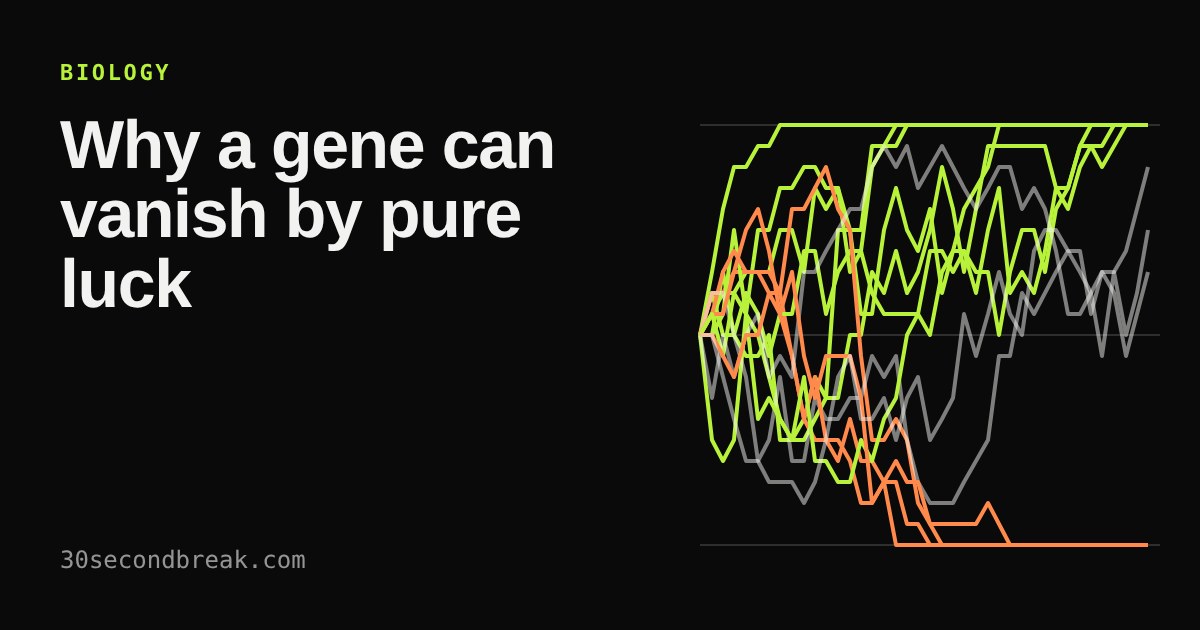
Two versions of a gene start at 50% each. Neither is better, yet in a small population one will vanish by pure chance and the other will take over. This is genetic drift: each generation is a random sample of the last, and a small sample rarely mirrors it.
Run twenty populations at once, shrink or grow them, and change the starting share to see how population size decides who gets stuck, from fruit flies in bottles to an island that remembers one storm.
Deep dive · 5 min
More in Biology
View all →
How thousands of fireflies flash in time with no leader: pulse-coupled oscillators
On riverbank trees in Southeast Asia, thousands of male fireflies flash together, with no leader and no shared clock. Each insect is just a small timer that…
Why fishing less gave the Adriatic more sharks: foxes, rabbits and a loop
When fishing slowed during the First World War, the Adriatic catch held a bigger share of sharks and rays, not a smaller one. Mathematician Vito Volterra…
How a leopard gets its spots: Turing's two-chemical pattern machine
A leopard's spots and a zebra's stripes start out as a smooth sheet of near-identical cells. In 1952 Alan Turing showed that two interacting chemicals, one…
How honeybees give directions by dancing in the dark
A honeybee that finds good flowers can tell her sisters where they are, inside a pitch-black hive, by dancing. She runs in a straight line while shaking her…
How a Venus flytrap counts to five without a brain
A Venus flytrap ignores the first touch. Brush one of its trigger hairs and nothing happens; brush a second within about half a minute and the jaws slam shut…
How chameleons change colour: they stretch a mirror made of crystals
A chameleon doesn't change colour by mixing pigments. Under its skin sit cells packed with tiny guanine crystals, arranged in a lattice that works like a…