Why adding a road can slow every driver down: Braess's paradox
30seconds
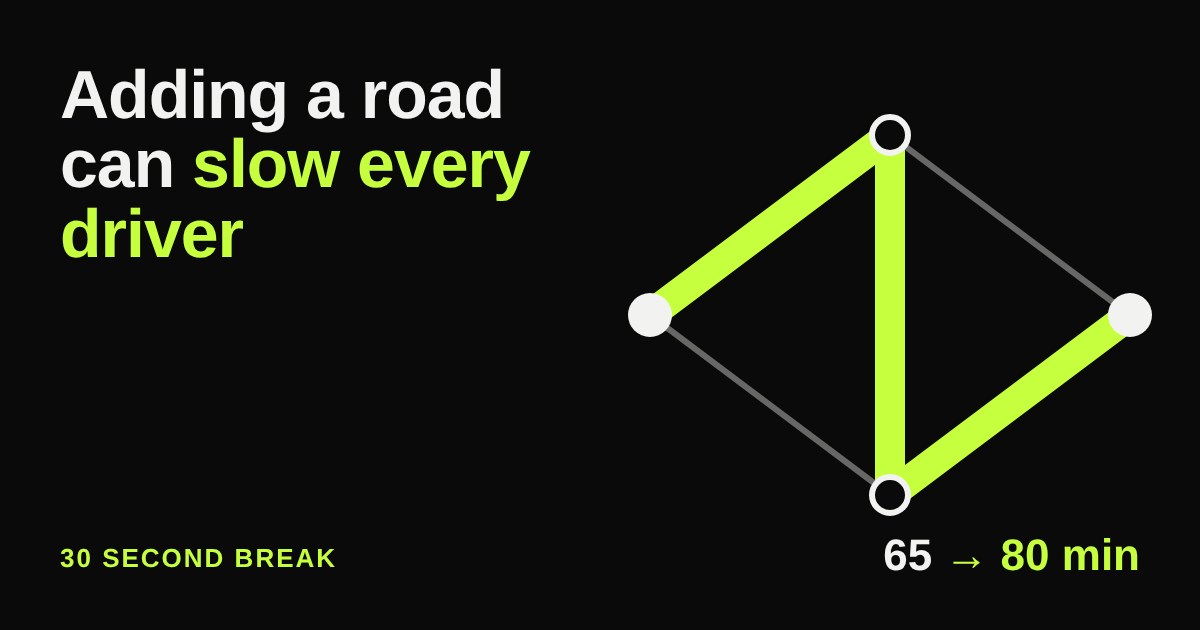
You would think a free shortcut can only help. In 1968 the mathematician Dietrich Braess showed it can make every driver slower.
In our four-road example, 4,000 drivers take 65 minutes each. Open a free link between the middle points and each driver is tempted to switch, because the zig-zag is quicker for the person switching. When everyone does, every trip takes 80 minutes, and no one can improve alone.
Open and close the shortcut and watch it happen.
Deep dive · 4 min
More in Economics
View all →
Why people bid more than a dollar for a dollar: Shubik's escalation trap
Auction a dollar bill with one twist: the second-highest bidder pays their bid too. It sounds harmless, yet in 1971 economist Martin Shubik reported that…
The winner's curse: why whoever wins an auction has usually overpaid
In 1983, MBA students bid on jars of coins worth exactly $8. On average they underestimated the jars, guessing $5.13. Yet the winning bids averaged $10.01, so…
Why shared fish, fields and water get used up, and how some places don't
When something is shared and nobody controls it, taking a bit more is always worth it for you. You keep the whole gain; the damage is split among everyone…