Why airliner windows have no corners: stress piles up at the tightest curve
30seconds
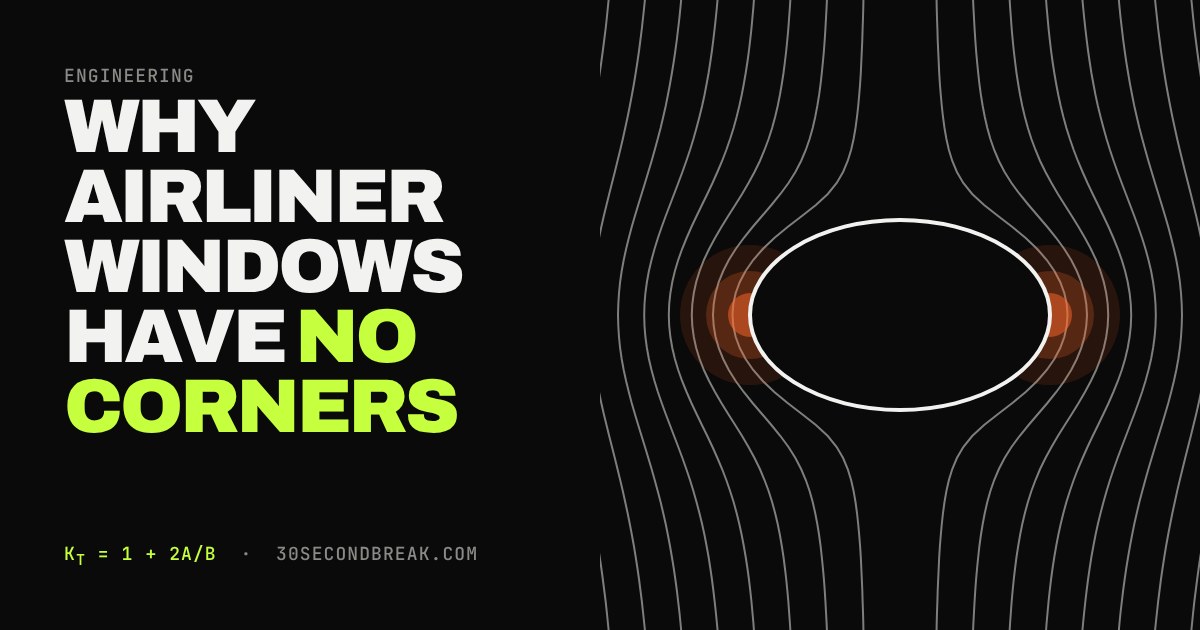
Cut a hole in a stretched plate and the force has to squeeze past it, so the metal beside the hole carries far more stress than the rest. For a round hole in a large plate the peak is exactly three times the average; for a sharp-cornered one it is much worse.
Reshape a hole yourself and watch the stress peak climb as the tip gets tighter. It is why the first jet airliner, the de Havilland Comet, cracked at the corners of its squarish windows, and why airliner windows have been rounded ever since.
Deep dive · 5 min
More in Engineering
View all →
Why steel beams are shaped like an I: the same steel, 25 times stiffer
Put a beam across a gap and it sags: the top edge is squeezed, the bottom stretched, and the steel in the middle does almost nothing. That is why girders are…
Why a stone arch stands without glue: Hooke's upside-down rope
A stone arch has no glue, yet it stands for centuries because every block is only ever squeezed. In 1675 Robert Hooke hid the secret in an anagram: as a…
Why a squeezed ruler bows sideways: Euler's buckling and the hollow tube
Squeeze a ruler between your palms and it doesn't crush: it bows sideways and gives way. That's buckling, and it decides how slender a column can be. Euler…
Why every bridge is made of triangles: a square frame folds, a triangle can't
Push on the corner of a square frame and it folds flat. Push on a triangle made of the same sticks and nothing moves. The reason is simple: three side lengths…
Why a 660-tonne steel ball swings to keep Taipei 101 still
Skyscrapers sway in the wind, and gusts that match the tower's own rhythm can make it sway more and more. Taipei 101's answer is a 660-tonne steel pendulum…
Hang a chain, flip it upside down, and you have the perfect arch
In 1675 Robert Hooke hid a building secret in an anagram. Decoded after his death, it said: as hangs a flexible cable, so, inverted, stand the touching pieces…