Why Latin p became English f: Grimm's law and the sound-shift chain
30seconds
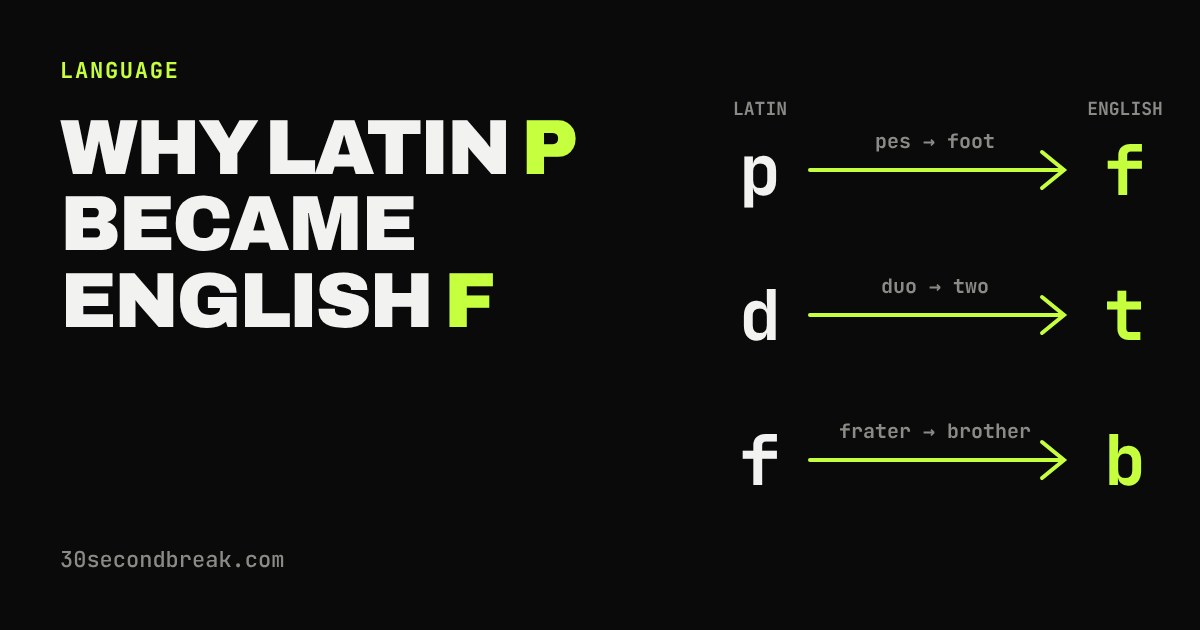
Latin says pes, English says foot. Latin tres, English three. Latin cornu, English horn. The swap is not random: when the Germanic languages split off, their consonants shifted in three linked steps, known as Grimm's law, after Jacob Grimm.
Press the three shifts in any order on twelve Latin words and watch them turn into English. Only one of the six possible orders works, because each shift pushes into the space the last one left.
More in Language
View all →
Why English plurals say s, z or iz: the wug test
Say 'cats' and 'dogs' out loud and listen to the last sound. One is a hiss, the other a buzz, and 'buses' adds a whole extra syllable. English spells all three…
Why the most common word is twice as common as the next: Zipf's law
Sort every word in a book from most to least common and a pattern appears: the top word is about twice as common as the second, three times as common as the…
Why “The old man the boat” reads as broken: garden-path sentences
Read this: The old man the boat. If it stalled you at the end, your brain did exactly what it always does: it guessed ahead and lost the bet. A garden-path…
Why the same sound is a b to English ears and a p to Spanish ears
Say "bat" and "pat". The only physical difference is a tiny delay between your lips opening and your vocal cords buzzing, about 12 milliseconds for an English…
Why Spanish sounds faster than Vietnamese yet says just as much
Listen to Spanish or Japanese and it seems to rush past; Vietnamese or Thai can sound almost unhurried. Yet when researchers timed 170 people reading the same…
Why everyone agrees which blob is 'bouba' and which is 'kiki'
Show people a soft blob and a spiky star and ask which one is bouba and which is kiki. The words are made up, yet in the classic version of the test about 95%…