Why switching doors wins twice as often: the Monty Hall problem
30seconds
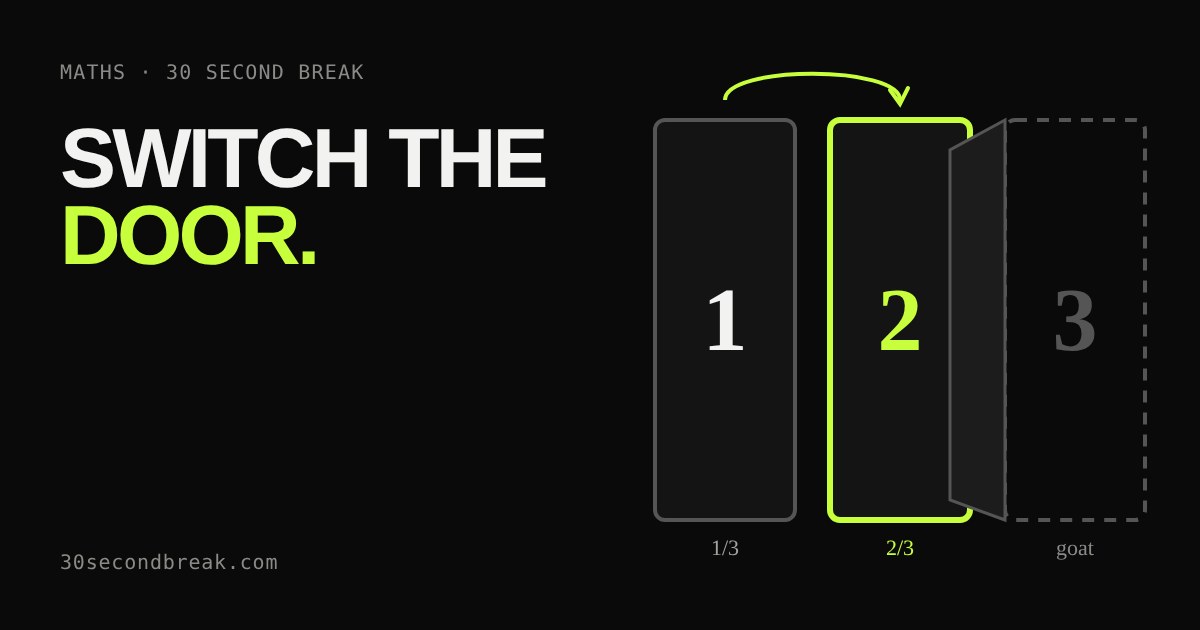
Three doors, one car. You pick one, the host opens a goat door, and offers a swap. Most people say it's 50/50. It isn't: switching wins twice as often as staying.
Play the game yourself, then let a simulation run 1,000 rounds at a time. Change one rule, a host who doesn't know where the car is, and watch the advantage vanish. The odds live in the host's rules, not in the number of doors left.
Deep dive · 4 min
More in Maths
View all →
Why 1 leads far more often than 9: Benford's law of first digits
Look only at the first digit of any long list of real-world numbers, such as river areas, populations or the figures in a company's accounts. You'd expect each…
How dropping needles on a floor reveals the number π: Buffon's needle
Toss a match onto a plank floor and ask: does it touch a crack? Do it thousands of times and the fraction that do will quietly spell out π, though no circle is…
Why 23 people are enough for two to share a birthday
Put 23 people in a room and there's a better-than-even chance that two of them share a birthday. That sounds wrong, because 23 is tiny next to 365. The catch…
Why turning a wobbly table can stop it rocking: the quarter-turn proof
Your café table rocks. Before you wedge a folded napkin under a leg, try turning the whole table on the spot. On most floors, somewhere within a quarter-turn…
Why seven shuffles are enough to mix a deck of cards
A 52-card deck can be put in about 8 × 10^67 different orders, yet a few quick shuffles leave a lot of the old order behind. In 1992 Dave Bayer and Persi…