Why washing hands saved mothers in 1847: Semmelweis and the two wards
30seconds
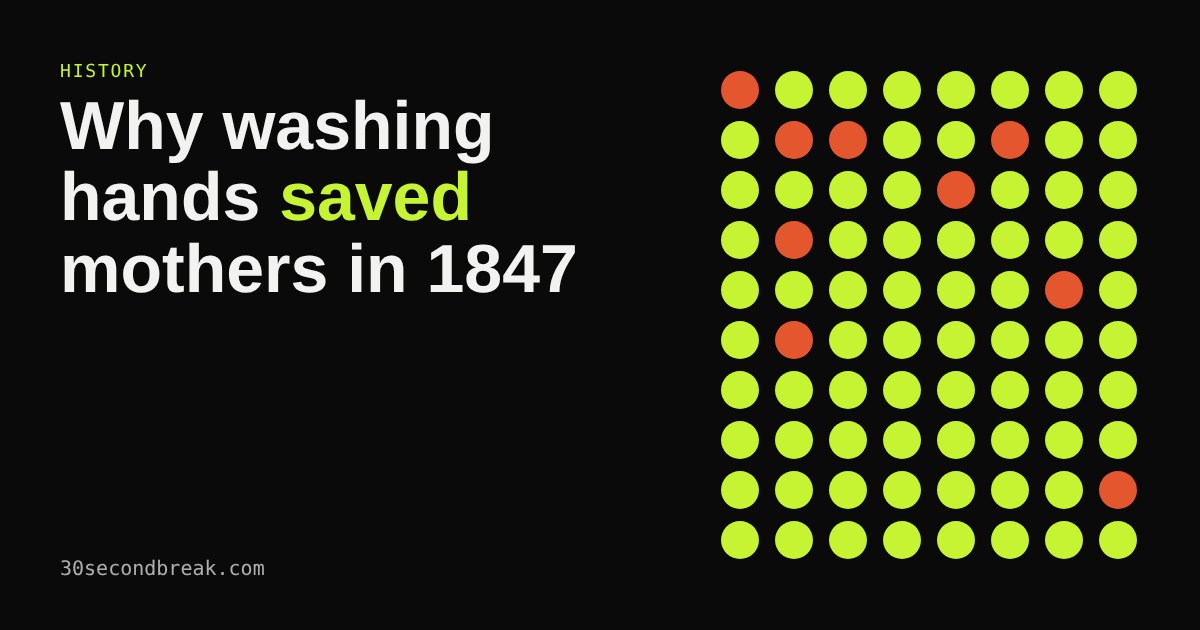
In 1846, mothers in one Vienna maternity ward died at four times the rate of mothers in the ward next door. The doctors' ward was losing 11.4% of its patients; the midwives' ward, 2.8%.
Ignaz Semmelweis worked out that the doctors were carrying something from the autopsy room to the delivery bed. When he ordered handwashing in chlorinated lime in 1847, deaths fell from 18.3% in April to 2.2% in June. Run the ward yourself and see how much washing it takes.
Deep dive · 3 min
More in History
View all →
How a 2,000-year-old bronze machine predicted eclipses with the number 223
In 1901, divers pulled a corroded bronze machine from a shipwreck off the Greek island of Antikythera. One dial ended in the number 223, written in Greek…
How one doctor's map traced a cholera outbreak to a single pump
In 1854 most doctors blamed cholera on bad air. When it tore through Soho, killing hundreds in days, John Snow went door to door asking one question: where did…
How a 9th-century scholar cracked secret codes by counting letters
For roughly nine centuries after Julius Caesar, swapping each letter for another was a perfectly good way to keep a secret. Then, in 9th-century Baghdad, the…
Why October 1582 lost ten days: a calendar year 11 minutes too long
In 1582, Thursday 4 October was followed by Friday 15 October. Ten dates were simply deleted across Catholic Europe. The reason was an error of about 11…
How Eratosthenes measured the whole Earth with a stick and a shadow
Around 240 BC, Eratosthenes, head of the Library of Alexandria, measured the size of the whole Earth with a stick and a shadow. At noon on midsummer, sticks in…
How sailors found longitude before satellites: a race against the clock
Latitude is easy: measure the height of the Sun or the Pole Star. Longitude is hard, because the Earth turns one degree every four minutes. To know how far…